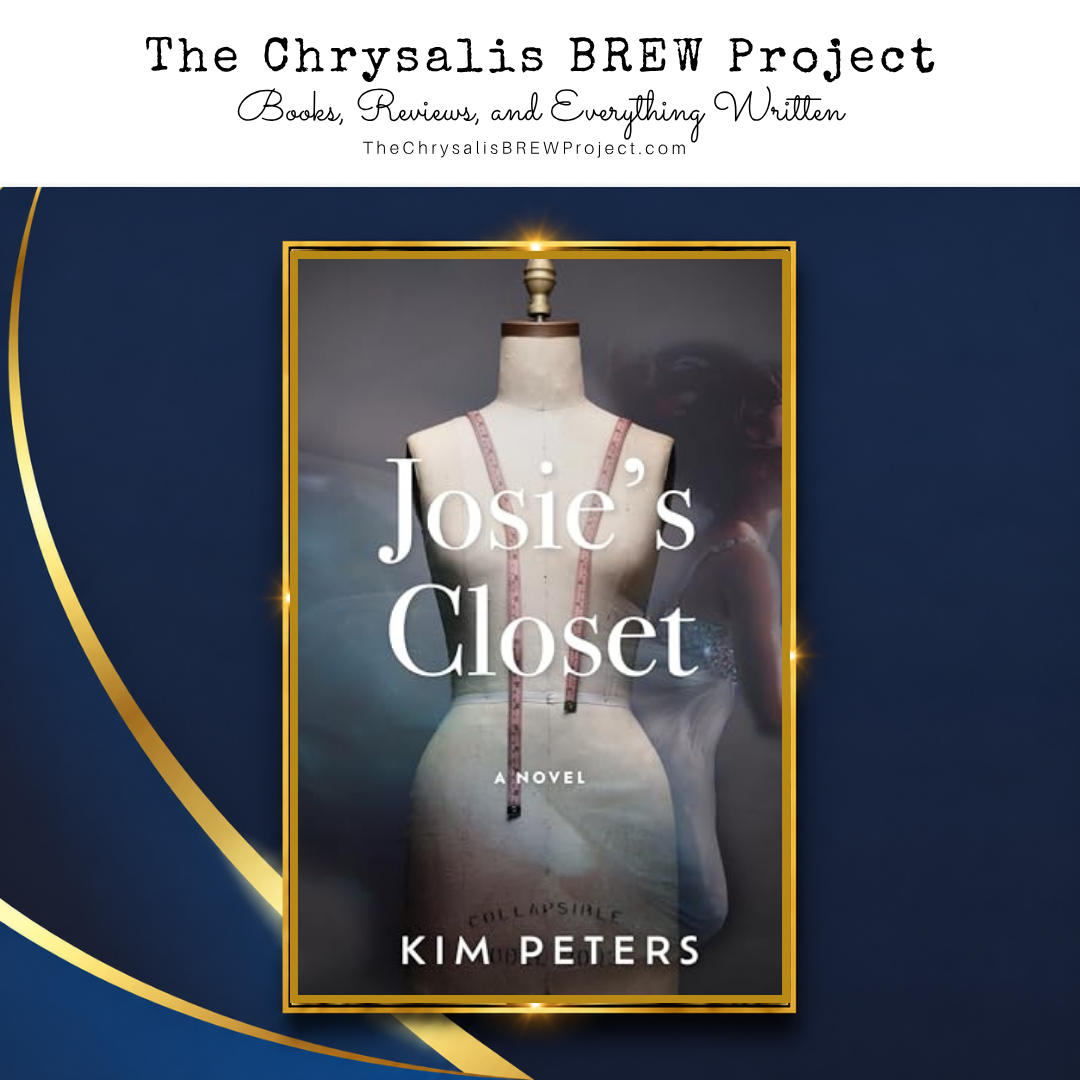
What happens when the safest room in your house is also the room where you have been hiding from yourself? Kim Peters’s Josie’s Closet follows a woman rebuilding her life after a painful marriage, only to discover that memory, imagination, family history, and identity can be far less tidy than any closet.
Table of Contents
Review
A story of memory, resilience, and reinvention.
There is an interesting scientific reality behind Josie’s Closet: memory is not a perfect recording of the past. Human recollection can be reconstructed, influenced by emotion, and altered by the way an experience is processed over time. Peters turns that familiar human vulnerability into one of the novel’s most intriguing narrative devices.
Josie Lambert begins the story in a lawyer’s office, facing the end of a thirteen-year marriage and carrying far more emotional baggage than she is willing to unpack. Her escape to the small community of Birdsong initially appears to be a conventional fresh start. Then the closet, the costumes, the memories, and the unexplained experiences begin pulling the story somewhere more psychologically complex.
What makes the novel particularly effective is the way its mystery is tied to Josie herself. The reader is not simply asking, “What happened?” but also, “What is happening inside Josie’s perception of what happened?” That distinction gives the story its psychological-thriller character without requiring sensationalism.
Peters also makes clothing unexpectedly important to the narrative. Josie is a costume designer, and garments repeatedly become vessels for memory and identity. The costumes are not merely professional props; they represent different versions of herself and, at times, a means of stepping outside the life she finds unbearable. Later, when she can finally handle the costumes without feeling compelled to disappear into their worlds, the change carries considerably more meaning than a simple career decision.
The details of the story reward attentive readers. The old brooch becomes a bridge between seemingly disconnected people and events. The fire at the Huxley home gradually develops from childhood tragedy into an unresolved family mystery. Tate’s discovery about his biological father changes the meaning of several earlier events. Even the peculiar garden gnomes provide a small moment of humor when Tate jokingly tells Josie, “I need to gnome, Josie.” And the final stone plaque for Hope, placed between Josie’s parents’ graves, quietly brings together the novel’s ideas about remembrance, loss, family, and moving forward. These details give the book a sense of internal architecture.
The writing is particularly strong when Peters allows physical surroundings to mirror emotional states. The opening law office feels cold and intimidating; the childhood fire is rendered through sensory impressions; Birdsong gradually becomes warmer and more inviting as Josie’s world expands. Savannah’s Forsyth Park, the Shamrock Ball, the old storefront destined to become Huxley and Hope Custom Designs, and the church wedding all contribute to a visual progression from confinement toward possibility.
There is also a welcome thread of humor running through the heavier material. Emma’s irreverence, Tate’s teasing, the “Jester and Killjoy” podcast joke, the unfortunate garden gnomes, and the imagined Roman statue in Mark’s proposed boutique design keep the narrative from becoming emotionally monochromatic. Those lighter moments matter because recovery rarely resembles a single uninterrupted emotional register.
The psychological material is handled through the story’s characters rather than presented as a technical textbook. Josie’s therapist helps her distinguish between a traumatic flashback and an imagined experience, while cognitive behavioral therapy and possible EMDR enter the narrative as parts of her recovery journey. The book consequently encourages an important question: if our minds sometimes protect us from overwhelming experiences in complicated ways, what might healing look like when avoidance is no longer enough?
The answer Peters develops is neither instantaneous nor perfectly neat. Josie gradually learns to identify triggers, seek support, establish boundaries, reconnect with creativity, and distinguish her present life from the experiences that shaped her. Her decision to experiment with ordinary fashion designs rather than immediately returning to costume work is especially meaningful because it represents creativity without surrendering control to it.
The novel’s strongest emotional movement comes late, when Josie finally confronts the people and memories she has spent years avoiding. Her conversation with Aunt Sylvie is particularly affecting because neither character is reduced to a simple villain or victim. Sylvie acknowledges that grief and avoidance shaped the way she raised Josie, while Josie recognizes her own fear and limitations. Their exchange allows forgiveness to emerge as understanding rather than as a convenient eraser of the past.
My favorite part is the cemetery scene following Emma and Tate’s wedding, because Josie’s small plaque for Hope transforms private grief into an act of remembrance and gives the title’s ideas of family, identity, and renewal a quietly powerful final image.
Readers who enjoy emotionally grounded psychological mysteries, women’s fiction with a suspenseful edge, family secrets, and stories about rebuilding after difficult life experiences are likely to find much to discuss here. Readers looking primarily for fast-paced procedural suspense, elaborate crime investigation, or a conventional supernatural time-travel adventure may find the novel less familiar than those descriptions suggest. The apparent journeys through other eras ultimately function within the novel’s psychological framework rather than becoming a traditional science-fiction mechanism.
In tone and subject matter, Josie’s Closet may remind some readers of the intimate psychological tension found in books by Liane Moriarty, while its focus on a woman’s reconstruction of identity after a damaging relationship can evoke the emotional territory of Kristin Hannah. Yet Peters gives the combination a distinct identity through costume design, small-town community, family mystery, and the unusual relationship between creativity and memory.
There are a few places where the prose could benefit from a final mechanical polish, but the overall presentation is clean and readable, and the handful of objective errors do not obscure the narrative. More importantly, the story knows what emotional journey it wants to take its protagonist on and carries that journey through to a hopeful conclusion.
Ultimately, Josie’s Closet is less interested in asking whether a person can erase the past than in asking a more useful question: Can the things that once helped us survive eventually become part of the life we choose to live? Peters answers through Josie’s gradual transformation, making the novel a thoughtful exploration of memory, resilience, family, and the courage required to reclaim one’s own story.
About the Author

Kim Peters is a former Registered Nurse and Board Certified Health Coach. Writing has been part of her life since childhood, from professional documents and journals to creative writing and unpublished speculative fiction. Her debut novel, Josie’s Closet, was released in July 2026. She draws on her work with people to develop characters and writes about their humanity. She lives with her husband, children, grandchildren, and extended family and enjoys traveling.
Book Details
- Title: Josie’s Closet
- Author: Kim Peters
- Genre(s): Fiction
- Sub-genre(s): Regional and Local Stories; Mystery/Crime/Thriller; Psychological Thriller
- Theme(s): Resilience; Trauma; Recovery; Abuse; Forgiveness; Family; Identity; Healing; Empowerment; Hope
- Minimum Audience Age: 18+ (Adult)
- Main language used in the text: English
Book Themes
(Note: 0=none, 1=a few, 2=considerable, 3=pronounced, 4=excessive)
- Sexual themes — 1: Romantic relationships and marriage, without explicit sexual content.
- Religious themes — 0: No substantive religious themes or religious instruction.
- Violence, self-harm, etc. — 3: Domestic violence, traumatic death, miscarriage, and psychological distress.
- Crude language, expletives, swearing, etc. — 2: Occasional profanity and insulting language appear in dialogue.
- Other adult themes — 3: Divorce, abuse, pregnancy loss, PTSD, alcohol misuse, and infidelity.
Disclaimer: The content provided by The Chrysalis BREW Project is for informational purposes only. The views expressed in our reviews and articles are those of the individual writers and do not necessarily reflect the official stance of The Chrysalis BREW Project. Unless otherwise specified, product descriptions or author profiles are based on what has been provided by the author or publisher. We strive for accuracy, but we cannot guarantee the completeness or reliability of the information provided. External links are for convenience and do not imply endorsement. Readers are encouraged to conduct their own research and consult professionals as needed. The use of our content is at your own discretion. Please read our full disclaimer version as well as other relevant policies, terms, and conditions on the links below for more details.
Important Reads: About Us | Privacy Policy | Terms of Service | Disclaimer and Disclosure
For more posts like this, here’s the link: https://thechrysalisbrewproject.com/category/bookish-posts/.
- A Calendar of BREW Events
- Book Reviews and Recommendations
- BREW Book, Blog, and Poetry Awards
- BREW Book Awards
- BREW International Blog Award
- BREW Poetry Award
- General Award Nomination Policies
- BREW Award Winners
- Become a BREW Awards Judge
- BREW Book Awards Judging Criteria
- BREW Brilliance: Insights and Updates from BREW Awardees
- Policy for Self-reporting, Reporting on Awardees, and Minimum Nominee Criteria
- From the BREW Community
- Get Featured: Showcase Your Work Through The Chrysalis BREW Project
- Giving Back
- Our Free Services for You
- What You Can Also Do
- Partner With Us
- Our Offers
- About
Announcements
Welcome to The Chrysalis BREW Project! We’re excited to offer new service slots to shine a spotlight on your masterpiece—place your order while spots last! If you have any questions, feel free to reach out through our Contact Form and we’ll get back to you as soon as we can. All the best, now and always—keep shining!
Congratulations to our latest BREW award winners!


Something went wrong. Please refresh the page and/or try again.


Share this:

Discover more from The Chrysalis BREW Project
Subscribe to get the latest posts sent to your email.